The Repair or Replace Question Across North Texas
Homeowners from Allen to Lewisville eventually hit the same crossroads: the roof has a problem, and now it's a question of whether to fix it again or start over. It's not always obvious which choice is the right one, especially when the roof looks fine from the driveway but keeps causing trouble inside.
Texas roofs deal with intense summer heat, sudden hailstorms, and high winds, all of which accelerate wear compared to milder climates. That means the repair-or-replace conversation tends to come up earlier here than in some other parts of the country, and getting the call right saves both money and headaches down the line.
Why This Decision Isn't Always Obvious
A roof can look mostly intact while hiding real trouble underneath, and a roof with a few missing shingles isn't automatically a lost cause. The factors that actually matter are age, pattern of failure, and how the roof's underlying structure and ventilation are holding up.
Roof Age and Material Lifespan
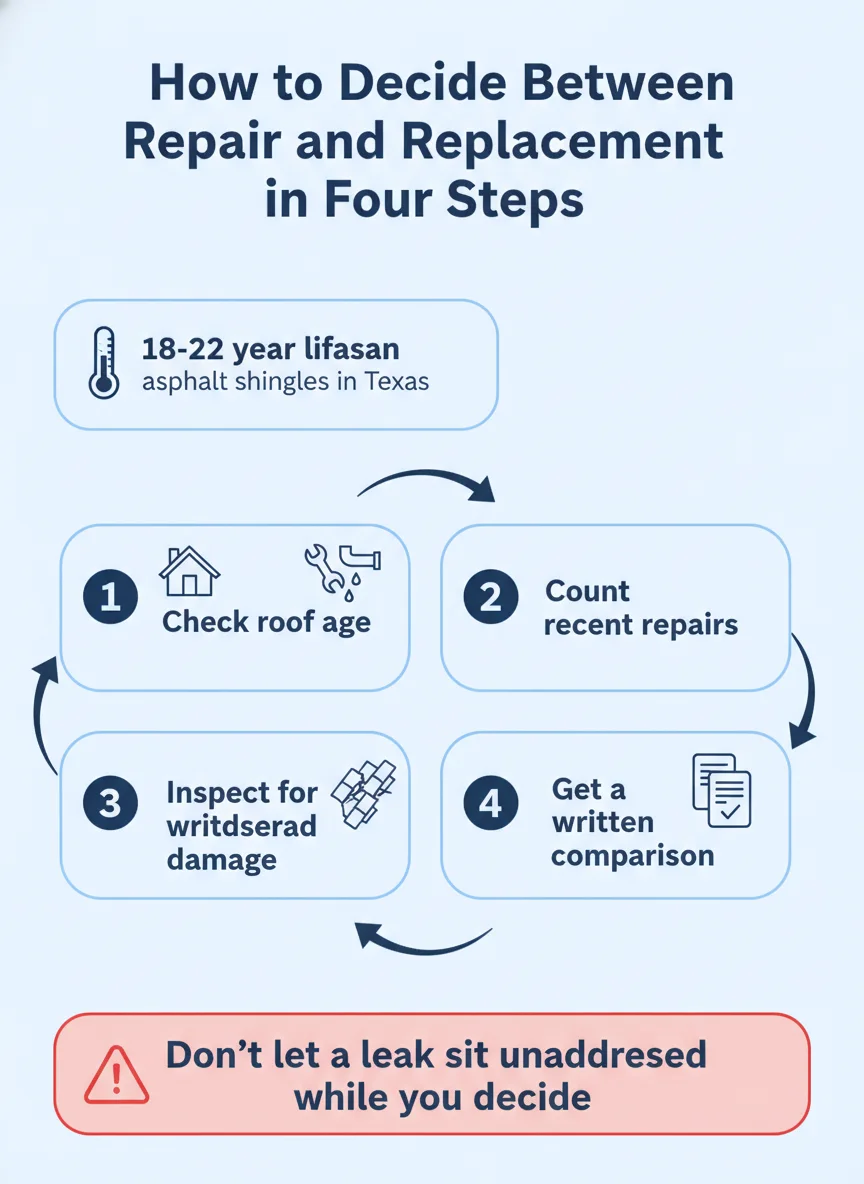
Asphalt shingle roofs in Texas typically last somewhere in the 18 to 22 year range across the industry, though that number shifts with ventilation quality, installation, and sun exposure. A roof well within that window with isolated damage is usually a good repair candidate.
A roof at or past that age range, even one that looks okay on the surface, is more likely dealing with brittle shingles and worn underlayment throughout, not just at the visible problem spot. That's when a repair often just delays a replacement that's coming anyway.
Pattern of Failure
One leak after one storm is a repair situation. Leaks that keep showing up in different rooms, or the same spot that keeps failing after being fixed, point to a bigger issue with the roof's overall condition rather than a single localized problem.
A pattern of failure across multiple areas of the roof usually means the materials underneath, not just the visible shingles, have degraded. That's a strong signal that a roof replacement will solve the problem more permanently than another round of patching.
| Situation | Repair Usually Fits | Replacement Usually Fits |
|---|---|---|
| Roof age | Well within expected lifespan | At or beyond typical 18-22 year range |
| Damage location | Isolated to one area | Spread across multiple sections |
| Repair history | First or second repair | Repeated repairs in the same or different spots |
| Underlying deck | Solid, no rot or soft spots | Soft decking or widespread moisture damage |
What Happens Underneath a Failing Roof
Shingles are only the top layer of a roofing system. Underneath sits the underlayment, decking, and ventilation that together keep water and heat out of the attic. When a roof starts failing, it's often this underlying system, not just the visible shingles, that's causing the recurring problems.
Poor attic ventilation accelerates shingle aging from underneath by trapping heat and moisture, which is part of why two roofs of the same age and material can be in very different condition. A ventilation and energy efficiency upgrade during a replacement often extends the life of the new roof beyond what the old one achieved.
Step-by-Step: How to Evaluate Your Own Roof
Before calling a roofer, homeowners can do some initial groundwork to understand where their roof stands. Here's a reasonable way to approach it.
- Check the paperwork: Find the install date if you have it, since roof age is one of the biggest factors in the repair-or-replace decision.
- Walk the attic: Look for daylight through the roof deck, water stains, or damp insulation, which point to a bigger issue than surface damage suggests.
- Note repair history: Write down how many times you've called for repairs and whether it's the same spot or different areas each time.
- Look from the ground: Check for curling, missing, or granule-bare shingles from a safe vantage point, which signal broader wear.
- Get a written assessment: Have a licensed roofer document findings and give a straightforward comparison of repair versus replacement for your specific roof.
What an Assessment Usually Reveals
When Repair Makes Sense
A roof with good bones, meaning solid decking and intact ventilation, that's dealing with an isolated issue like a damaged flashing seal or a small section of wind-lifted shingles is usually a strong repair candidate. Fixing the specific problem area restores the roof's protection without unnecessary cost.
Younger roofs, generally those well under the typical lifespan for their material, almost always fall into this category unless they've suffered significant storm damage that affects a large portion of the surface.
When Replacement Makes Sense
A roof nearing or past its expected lifespan, especially one with a documented history of repeat repairs, is usually better served by full replacement. Continuing to patch an aging roof means paying for labor repeatedly while the underlying materials keep degrading.
Roofs with widespread granule loss, soft decking found in multiple spots, or storm damage affecting a large percentage of the surface area also tend to point toward replacement rather than piecemeal repair.
DIY vs Calling a Licensed Roofer
Homeowners can handle some early-stage monitoring themselves, like checking the attic for daylight or water stains and keeping a record of past repairs. This groundwork helps a roofer give a faster, more accurate assessment when they arrive.
Actual repair or replacement work should always go to a licensed roofing contractor. Climbing onto a roof without proper safety equipment is genuinely dangerous, and incorrect shingle or flashing installation can void manufacturer warranties and lead to leaks that are harder to diagnose later.
A roofer's assessment also carries more weight than a homeowner's visual check because it includes moisture readings, a decking inspection from the attic side, and an honest read on whether the roof's age and condition still support a repair-only approach.
Making the Call With Confidence
The repair-or-replace decision doesn't have to feel like a guessing game. Roof age, damage pattern, and repair history together tell a pretty clear story once someone takes the time to look at all three, and a written comparison from a roofer removes most of the uncertainty.
Absolute Professional Roofing Contractors gives homeowners across the DFW Metro a straightforward look at both options before recommending either one.
Frequently asked questions
How do I know if my roof needs to be repaired or replaced?
The decision usually comes down to roof age, how widespread the damage is, and how many times you've already repaired the same area. A roof nearing the end of its expected lifespan with recurring leaks in different spots is usually a replacement candidate, while an isolated issue on a younger roof is often a repair.
Is it cheaper to repair my roof than replace it?
A single repair typically costs less upfront than a full replacement, but repeated repairs on an aging roof can add up over time without solving the underlying problem. A roofer can walk you through whether ongoing repairs still make financial sense for your situation.
How many roof repairs is too many?
There's no fixed number, but if you're calling for repairs more than once a year or the same area keeps failing after being fixed, that's a sign the roof's underlying materials are wearing out rather than facing isolated damage.
Can I replace just part of my roof instead of the whole thing?
Partial replacement is sometimes possible if the damage is contained to one section and the rest of the roof is in good condition and a similar age. A full roof assessment determines whether a partial replacement will match and perform well with the existing material.
Does roof age alone mean I need a replacement?
Age is a strong factor but not the only one. A well-maintained roof nearing the end of its typical lifespan may still be doing fine, while a younger roof with poor ventilation or storm damage can need replacement sooner than expected.