
Why Homeowners Wait, and What It Costs Them
It's an easy trap to fall into: a small leak shows up after a storm, it doesn't seem urgent, and life gets busy. Homeowners across Richardson, Garland, and the rest of the DFW Metro put off roof repairs all the time for exactly this reason, figuring they'll deal with it when it gets worse.
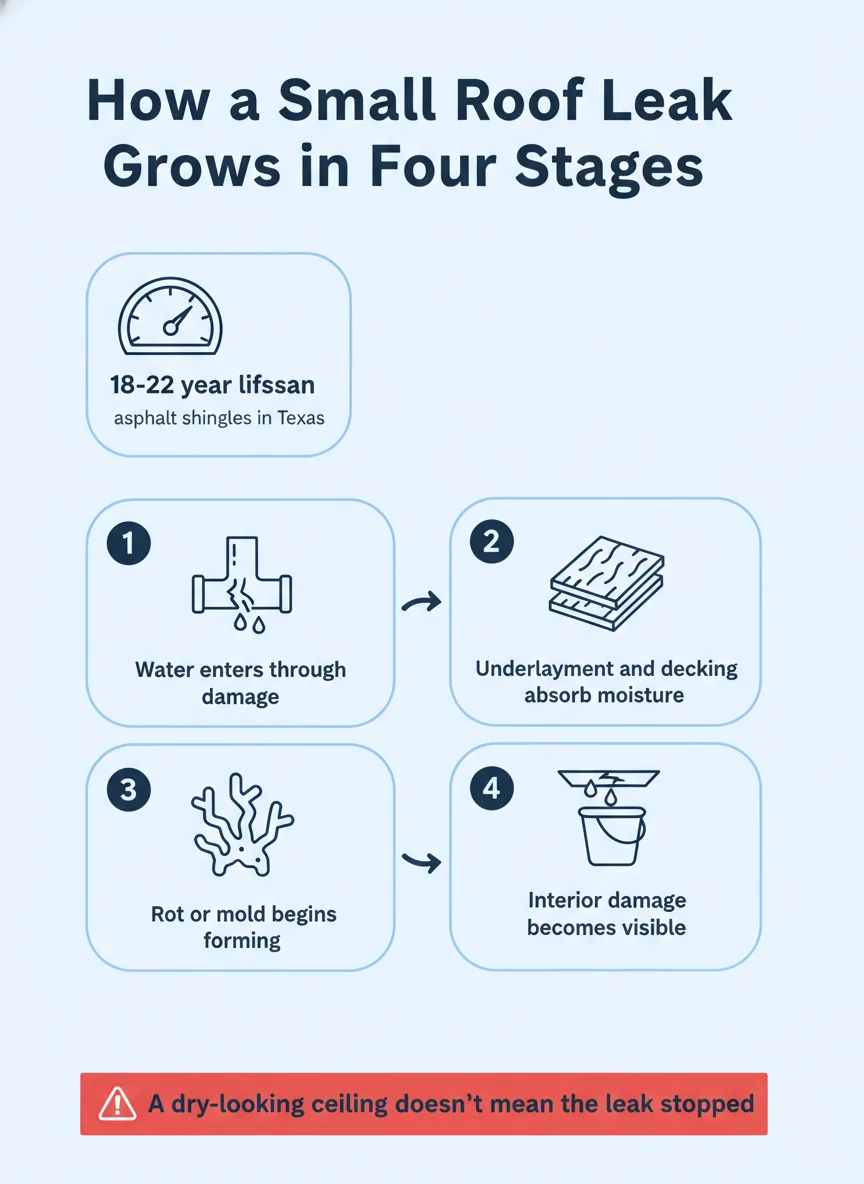
The problem is that roof damage rarely stays contained to where it started. Water finds paths along decking and underlayment that aren't visible from inside the house, so the delay between noticing a small issue and seeing real interior damage can be longer, and more expensive, than most people expect.
What Actually Happens While You Wait
Once water gets past the shingle layer, it's working against wood and insulation that weren't designed to handle ongoing moisture exposure. The longer that exposure continues, the more of the roofing system gets affected.
The First Few Weeks
In the early stage, moisture soaks into the underlayment and starts working into the decking below it. This stage often shows no visible signs inside the house yet, which is exactly why homeowners assume the issue is minor or has resolved on its own.
Texas heat actually works against the roof here too, since repeated heating and cooling cycles combined with trapped moisture create ideal conditions for wood to weaken faster than it would in a stable, dry environment.
The Following Months
As moisture continues to sit in the decking, rot sets in and the wood loses structural integrity. This is also when mold growth typically becomes a concern, since damp wood in an enclosed attic space provides exactly the environment mold needs to spread.
By this stage, the original damaged area has usually grown, and a repair that would have addressed a small section of decking now needs to cover a wider area, sometimes prompting a conversation about roof repair scope that's larger than it would have been originally.
| Timeframe | What's Happening | What It Looks Like |
|---|---|---|
| Weeks 1-4 | Moisture enters underlayment and decking | Little to no visible sign inside the home |
| Months 1-3 | Decking begins to soften, mold risk increases | Faint ceiling discoloration may appear |
| Months 3+ | Rot spreads, structural wood weakens | Visible stains, sagging, or musty odor |
The Roofing System's Weak Points
Every roof has a handful of areas most prone to leaks: flashing around chimneys and vents, valleys where two roof planes meet, and any spot where a penetration breaks the shingle layer. These are the areas most likely to be the source of an unaddressed leak.
Flashing failures in particular are deceptive because the damage happens gradually as sealant breaks down or metal shifts slightly over time, rather than all at once during a single storm. A repair caught early at a flashing point is usually straightforward, but one left alone can let water travel well beyond the original failure point.
Step-by-Step: What to Do When You Spot a Leak
Acting quickly on a suspected leak makes a real difference in how contained the eventual repair stays. Here's a practical sequence.
- Note the location: Mark where you first see a stain or drip, since the visible spot inside often doesn't match exactly where the roof damage started.
- Check the attic: Look for damp insulation, dark staining on decking, or daylight coming through, which confirm an active leak path.
- Limit further exposure: If safe to do so, place a container to catch dripping water and avoid running fans that could spread mold spores.
- Call for an inspection: Get a licensed roofer out to identify the source before more rain or heat cycles worsen the affected area.
- Get repair scope in writing: Once the source is found, get a clear written scope of what needs to be repaired and why before work begins.
What an Inspection Usually Finds
Caught Early
When a leak is caught within the first few weeks, an inspection typically finds damage contained to a small section of decking or underlayment. Repair in these cases is usually straightforward, targeting the specific failure point without needing to open up a wider area of the roof.
Homeowners who report leaks quickly also tend to have an easier time with insurance, since the damage timeline is clear and doesn't raise questions about ongoing neglect.
Caught Late
When a leak has been active for months, an inspection often finds rot extending beyond the original damage point, sometimes affecting framing members and not just the decking layer. This turns what could have been a contained repair into a more involved project.
Mold found during a late-stage inspection can also complicate the repair, since remediation may need to happen before roofing work can proceed, adding time and cost that early action would have avoided.
DIY vs Calling a Pro
Homeowners can safely do some early monitoring themselves, like checking the attic periodically for signs of moisture or keeping an eye on ceiling paint for subtle discoloration. Catching a problem early is genuinely within a homeowner's reach without climbing on the roof.
Once a leak is suspected, tracing the actual source and making the repair is a job for a licensed roofer. Roof surfaces are dangerous to walk without proper equipment, and misdiagnosing a leak's origin point is common enough that a professional inspection saves time even when it feels like an extra step.
The cost of a repair rarely justifies putting off the inspection itself. Even if the answer turns out to be a small, inexpensive fix, knowing that for certain is worth more than months of uncertainty about what's happening above the ceiling.
The Real Cost of Waiting
A roof leak that gets addressed quickly usually stays a small, contained job. The same leak left alone through a few months of Texas heat and rain tends to grow into something that affects decking, framing, and sometimes indoor air quality through mold.
Absolute Professional Roofing Contractors encourages homeowners across the DFW Metro to call as soon as a leak is suspected rather than waiting to see if it gets worse.
Frequently asked questions
What happens if I don't fix a small roof leak right away?
A small leak that's left alone typically keeps letting water into the decking and insulation even if you don't see a new stain right away. Over time this leads to wood rot, mold growth, and a repair that costs more to fix than the original issue would have.
How fast does roof damage get worse if I wait?
The speed depends on the type of damage and how much rain or heat the roof sees, but even a slow leak compounds over weeks and months. Texas heat and sudden storms both accelerate the process compared to a mild, dry climate.
Can a small roof repair turn into a bigger project if I wait too long?
Yes, this is one of the most common ways homeowners end up needing a larger repair or even a partial replacement. Water that spreads under shingles or along decking can affect a much bigger area than where the original damage occurred.
Will my insurance still cover roof damage if I wait to report it?
Delaying a claim can complicate coverage, since insurers may question whether ongoing damage resulted from the original event or from neglect afterward. Reporting damage and getting an inspection promptly protects your position with the claim.
Is it safe to just monitor a leak instead of repairing it?
Monitoring a leak instead of repairing it is rarely a safe long-term strategy, since moisture problems usually progress even when they're not visibly worsening on the surface. A licensed roofer can tell you whether an area truly needs immediate attention.