
Why Downspout Sizing Gets Overlooked Until It's a Problem
Most homeowners never think about downspout count or size until a hard rain sends water spilling over the gutter edge right onto a walkway or flower bed. Across North Texas, where downpours can drop a lot of water in a short window, an undersized downspout system shows its weak points fast, usually right at the corners where two gutter runs meet.
Downspout sizing is simple in concept: each downspout has to move as much water as the roof section feeding it can produce during a heavy rain. When the roof area draining into one downspout is too large, or the downspout itself is too narrow, the gutter fills faster than it can empty and overflows.
What Determines How Much Roof Area a Downspout Can Handle?
The rule of thumb used across the industry puts a residential downspout somewhere around 600 to 800 square feet of roof area, but that number moves depending on gutter trough size, downspout diameter, and how steep the roof is. A steeper pitch sheds water faster, which pushes more volume toward the gutter in a shorter window.
Gutter and downspout size
A standard 5-inch gutter paired with a 2x3 inch downspout handles less volume than a 6-inch gutter with a 3x4 inch downspout. Larger homes, steeper roofs, or areas that see intense rainfall benefit from the larger sizing even if the roof area per downspout stays similar, since the bigger downspout clears the gutter faster and reduces overflow risk during the heaviest part of a storm.
This is one reason seamless 5-inch and 6-inch gutters get chosen based on more than just looks. Matching the gutter and downspout size to the roof's actual water volume is what keeps the system working during the worst rain of the year, not just an average one.
Roof pitch and valley concentration
Roof valleys concentrate water from two roof planes into a single stream, and a downspout positioned near a valley outlet often needs to handle more than the flat square-footage math would suggest. A roof with multiple valleys draining to one corner puts real pressure on whatever downspout sits there.
This is why downspout planning during a reroof looks at more than total roof area, it looks at where the water actually concentrates. A roof with a complex layout of hips and valleys often needs downspouts placed and sized differently than a simple gable roof of the same total area.
| Roof Feature | Effect on Downspout Load | Typical Adjustment |
|---|---|---|
| Simple gable roof | Even water distribution across gutter runs | Standard spacing near 600-800 sq ft per downspout |
| Roof with valleys | Water concentrates at valley outlets | Larger downspout or added spout near the valley |
| Steep pitch (8/12+) | Faster runoff volume during heavy rain | Larger gutter trough and downspout diameter |
How the Gutter System Fits Together
The gutter trough collects water running off the roof edge, and it has to be sloped correctly toward each downspout to actually move that water rather than let it sit. A trough that's level or sloped the wrong way defeats even a well-sized downspout, since the water pools instead of flowing toward the outlet.
Downspouts themselves usually include an elbow at the top to connect to the gutter outlet and another near the bottom to direct water away from the foundation. Extensions at the base matter too, since a downspout that dumps water two feet from the foundation on a slab home just relocates the moisture problem instead of solving it.
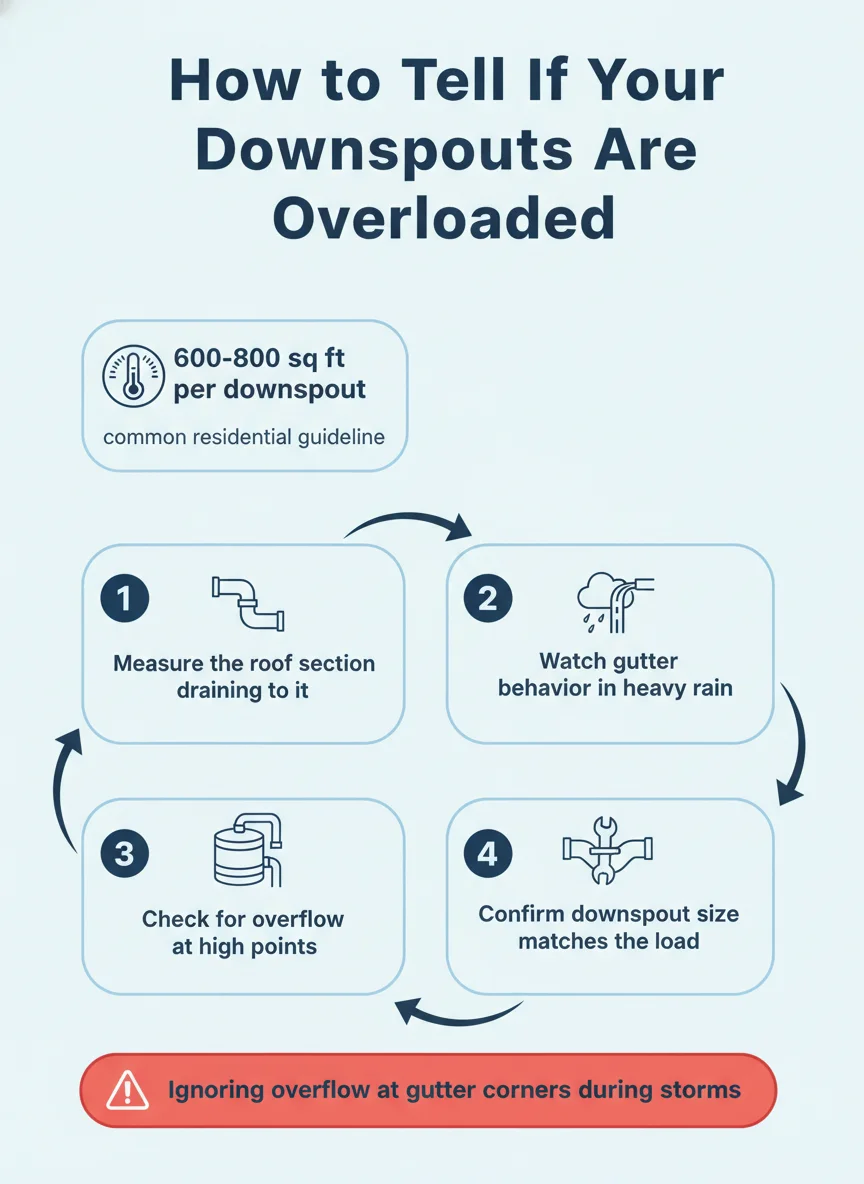
Step-by-step: Checking Whether Your Downspouts Are Sized Right
This is a check you can do during or right after a heavy rain, without climbing anything.
- Watch during a storm: During a heavy rain, watch each gutter run for overflow, especially at corners and the midpoint between downspouts.
- Note overflow location: Overflow right above a downspout usually points to the downspout itself being undersized, while overflow at a far corner points to spacing.
- Estimate roof section area: Roughly measure the roof section draining into each downspout to see if any one section is carrying an outsized share.
- Check downspout diameter: Compare your downspout size to the gutter trough size to see if they're mismatched.
- Inspect for clogs first: Rule out debris buildup before assuming a size problem, since a clogged downspout mimics an undersized one.
- Check extension length: Confirm downspout extensions carry water at least a few feet from the foundation, especially on slab homes.
What Overflow and Pooling Actually Tell You
Overflow at a single corner
When overflow happens consistently at one corner rather than along the whole run, that usually points to either a slope problem in that section of gutter or a single downspout trying to handle too much roof area. Adding a downspout at that corner or correcting the slope often solves it without redoing the whole system.
If the overflow is tied to a roof valley dumping extra water into that corner, the fix might involve resizing just that section rather than the whole gutter run, which keeps the repair contained and affordable relative to a full system replacement.
Water pooling at the foundation
Pooling at the foundation, even with functioning gutters, often traces back to short downspout extensions dumping water too close to the house. On slab foundations common across North Texas, that moisture swing at the perimeter is a real concern over time, contributing to cracking and shifting.
This is a straightforward fix in most cases, extending the downspout discharge point further from the foundation, sometimes with an underground drain line routed to a safe discharge point on the property.
What You Can Handle Yourself vs. What Needs a Pro
Clearing debris from gutters and downspouts, and checking extension length, are both things a homeowner can manage safely from a ladder on a dry day. These simple checks solve a surprising number of overflow complaints without any system changes at all.
Resizing downspouts, adding a new one, or correcting gutter slope calls for a professional, since it involves understanding how the whole roof drains and where the real water volume concentrates, not just where the overflow shows up.
A gutter contractor can also spot whether the issue is tied to the roof itself, like a valley dumping more water than the system was designed for, which sometimes surfaces during a broader look with roof repair work.
Getting the Whole System Sized Right
Downspout sizing isn't a detail worth guessing at, especially in a region where heavy rain shows up fast and the water has to go somewhere the moment it hits the roof. Getting the trough size, downspout diameter, and spacing right the first time avoids years of overflow complaints and foundation moisture swings.
For homes dealing with a roofing project that touches drainage anyway, it's worth reading how overhang depth changes runoff patterns in our guide on roof overhang sizing, since the two systems work together more than most homeowners realize. Absolute Professional Roofing Contractors sizes gutters and downspouts to match the actual roof they're installed on, not a one-size-fits-all number.
Frequently asked questions
How much roof area can one downspout handle?
A common residential guideline is somewhere around 600 to 800 square feet of roof area per downspout, though it varies with gutter size, downspout diameter, and roof pitch. Steeper roofs shed water faster and put more demand on the downspout during heavy rain.
What happens if a roof has too few downspouts?
Water backs up in the gutter faster than it can drain, which causes overflow at the low points and corners during heavy rain. Over time that overflow erodes landscaping, pools at the foundation, and can work its way behind fascia boards.
Does downspout size matter as much as the number of them?
Yes, a wider downspout moves more water per minute even if there's only one, so it's a combination of count and diameter, not just how many downspouts a house has. A 3x4 inch downspout carries noticeably more volume than a 2x3.
Can I add a downspout to an existing gutter system?
In most cases yes, an additional downspout can be added to an existing run without replacing the whole gutter system, as long as the gutter itself is in good condition and properly sloped.
How do I know if my downspouts are undersized?
Watch your gutters during a hard rain. If water is spilling over the front edge at corners or low points rather than draining through the downspout, that's a sign the system is undersized for the roof area feeding it.