
Why Storm Season Prep Matters Across North Texas
The DFW Metro sees its share of hail and straight-line wind, usually building from late winter into early summer. Roofs that have sat through a Texas summer of UV exposure are already a little more brittle than they were a year ago, and that's exactly the condition a hailstone or a gust of wind finds them in. A few minutes of prep each spring puts you in a much better position, whether that means catching a loose flashing seam before it leaks or simply knowing what your roof looked like the week before a storm rolled through.
Skipping this step doesn't usually cause a problem overnight. It's the small stuff, a lifted shingle tab, a clogged downspout, a gap around a vent boot, that turns into a real leak once wind-driven rain finds it. And if a storm does cause damage, not having a clear picture of your roof's condition beforehand can make the insurance conversation longer and more frustrating than it needs to be. A little time now saves a lot of hassle later.
What Actually Happens To A Roof Before Hail And Wind Season
Asphalt shingles are built to shed water and flex with temperature swings, but Texas heat and UV exposure wear that flexibility down faster than in milder climates. By the time storm season arrives, shingles that were installed years ago have already lost some of their granule coating and elasticity, which is exactly what makes them more vulnerable to impact and wind uplift.
Aging Shingles And Granule Loss
Granules protect the asphalt layer underneath from UV breakdown, and they wear off gradually over the life of the roof. You'll usually notice this first as small colored grains collecting in your gutters or at the base of downspouts. A roof with heavy granule loss going into storm season has less protection left, which means hail impact and wind stress do more damage than they would on a newer surface.
Once granule loss gets significant, shingles start to look faded, brittle, or slightly curled at the edges. That curling is important because it creates a lip for wind to grab, which is how a single strong gust can turn into several missing shingles. Catching this stage before storm season means you're dealing with a repair, not a full roof replacement, after the first bad storm.
Weak Points: Flashing, Vents, And Gutters
Flashing around chimneys, skylights, and roof-to-wall transitions is one of the most common places a roof starts leaking, because it relies on sealant and metal fit rather than the shingles themselves. Sealant dries out and cracks with sun exposure, and once that seal fails, wind-driven rain during a storm finds its way in fast.
Gutters and vents matter here too. A gutter packed with debris can't move water off the roof fast enough during a heavy downpour, which backs water up under the shingle edge. Vent boots, the rubber collars around plumbing stacks, dry out and crack the same way flashing sealant does, and they're an easy thing to miss from the ground.
| Area Checked | Before Prep | After Prep |
|---|---|---|
| Shingles | Granule loss and curling go unnoticed | Worn areas identified and documented |
| Gutters | Debris blocks water flow during storms | Clear channels move water off the roof |
| Attic | Hidden leaks develop unseen | Daylight gaps and stains caught early |
| Flashing | Cracked sealant lets water in | Weak seals flagged before they fail |
The Systems That Take The Hit: Shingles, Flashing, and Gutters
Your roof isn't one surface, it's a system of layers working together. The shingles are the visible first line of defense, but underlayment, flashing, and ventilation all play a role in how well the roof handles a storm. When one part is weak, it puts more stress on the others, which is why a small flashing leak can eventually show up as attic mold or ceiling staining far from where the actual failure started.
Gutters are part of this system too, even though they don't sit on the roof plane itself. Their job is to move water away from the fascia and foundation fast enough that it never has a chance to back up under the shingles. Clean, properly pitched gutters reduce the load on the rest of the roof system during a heavy storm, which is part of why they're worth checking alongside the shingles themselves.
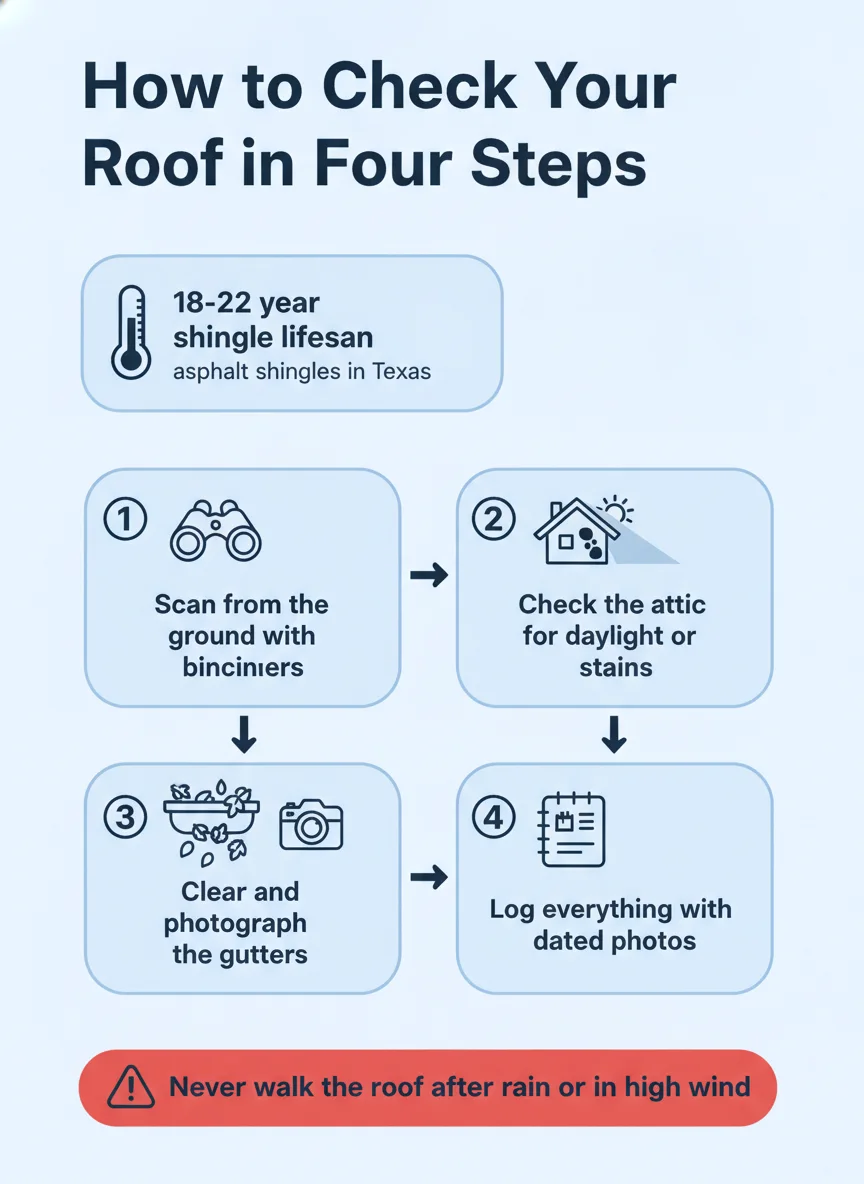
Step-by-step: How to Walk Your Roof and Attic Before Storm Season
You don't need to get on a ladder to do most of this. A pair of binoculars, a flashlight, and a clear day are enough to catch the majority of pre-storm warning signs before you ever call for a professional look.
- Scan from the ground: Walk the perimeter of your house with binoculars and look for curled, missing, or discolored shingles on each roof plane.
- Check attic daylight: Go into the attic during the day with the lights off and look for pinpoints of light coming through the decking.
- Feel for moisture: Run a hand along attic rafters and insulation near the eaves, checking for damp spots or staining.
- Clear the gutters: Remove leaves and debris from gutters and downspouts so water has a clear path off the roof.
- Check vent boots: Look at plumbing stack collars and roof vents for cracking or gaps around the base.
- Photograph everything: Take dated, wide-angle photos of each roof plane, the gutters, and any attic issues you find.
What You'll Find: Diagnosing Wear Before It Becomes a Leak
Signs You Can See From the Ground
From ground level, look for shingles that appear darker or shinier in patches, which often means granule loss has exposed the asphalt underneath. Curled edges, cracked tabs, and shingles sitting slightly askew are all visible without a ladder and are worth noting before the next round of wind.
Sagging gutter sections, streaking down the siding, or standing water pooling near the foundation after a light rain are also ground-level clues. None of these guarantee a problem, but together they build a picture of where your roof is most likely to struggle when a real storm arrives.
Signs You'll Only Catch With Documentation
Some wear only shows up when you compare photos over time. A small stain on the attic decking might look minor in isolation, but if it's larger than it was last spring, that's a sign of an active, slow leak rather than old residual moisture.
This is also where a professional inspection earns its keep. A trained eye can spot subtle granule loss patterns or flashing gaps that are easy to miss without experience, and a written report with photos gives you a clear record to work from if a storm does cause damage later in the season.
DIY vs Calling a Pro Before Storm Season
The ground-level scan, attic check, and gutter clearing are all things a homeowner can reasonably handle without special tools. These tasks don't require getting on the roof itself, and doing them yourself a couple of times a year is a good habit that catches obvious problems early.
Where it makes sense to call in a professional is anything that requires actually walking the roof surface or getting close to flashing details around chimneys and skylights. Aging shingles can be more slippery and fragile than they look, and a fall risk isn't worth saving a phone call. A trained roofer also knows what subtle wear patterns actually mean for the roof's remaining life.
If you find anything during your own check, from curling shingles to a damp attic spot, that's the point to bring in a professional for a closer look rather than guessing at the severity yourself. Catching it before storm season means the fix is usually smaller and less disruptive than dealing with it after a storm has already found the weak spot. If damage does happen, Storm & Hail Restoration covers everything from the inspection through the insurance side.
Get Ahead Of Storm Season This Year
A roof rarely fails all at once. It's usually a string of small, unaddressed issues that finally give way during the first serious storm of the season, and by then you're dealing with water intrusion instead of a simple repair. Homeowners across Plano and the surrounding DFW Metro deal with the same seasonal pattern every year, which is exactly why a spring checklist is worth the half hour it takes.
If your own walkthrough turns up something you're not sure about, or you'd rather have a documented baseline before the season gets underway, a free inspection is a fast way to get a clear answer. For more on how the insurance side works if damage does occur, see our guide on filing a roofing insurance claim in Texas. Absolute Professional Roofing Contractors is available across the metro for these seasonal checks.
Frequently asked questions
When should I have my roof checked before storm season?
Late winter or early spring, before the first heavy hail or wind events of the year, is the best window. That gives you time to fix small problems before they become urgent, and it gives you a documented baseline in case a storm does hit.
What should I photograph on my roof before a storm?
Take wide shots of every roof plane, close-ups of any existing wear, and photos of your gutters, downspouts, and attic ventilation. These photos establish a pre-storm condition record, which is useful if you ever need to show an adjuster what changed after a specific weather event.
Can I inspect my own roof safely?
You can check a lot from the ground with binoculars and from inside your attic with a flashlight, and that's the safest way to catch obvious problems. Walking the roof itself is best left to a professional, since granule loss and aging materials can make footing unpredictable.
What are the early warning signs of roof damage in Texas?
Look for granules collecting in gutters, shingles that look curled or cupped, dark streaks on the ceiling, and daylight visible through the attic decking. Any of these point to wear that's worth a closer look before storm season adds stress to the system.
Does storm prep help with an insurance claim later?
Yes, having dated before photos makes it much easier to show what damage occurred during a specific storm versus what was pre-existing wear. It won't guarantee coverage, but it removes a lot of the back-and-forth that slows claims down.